

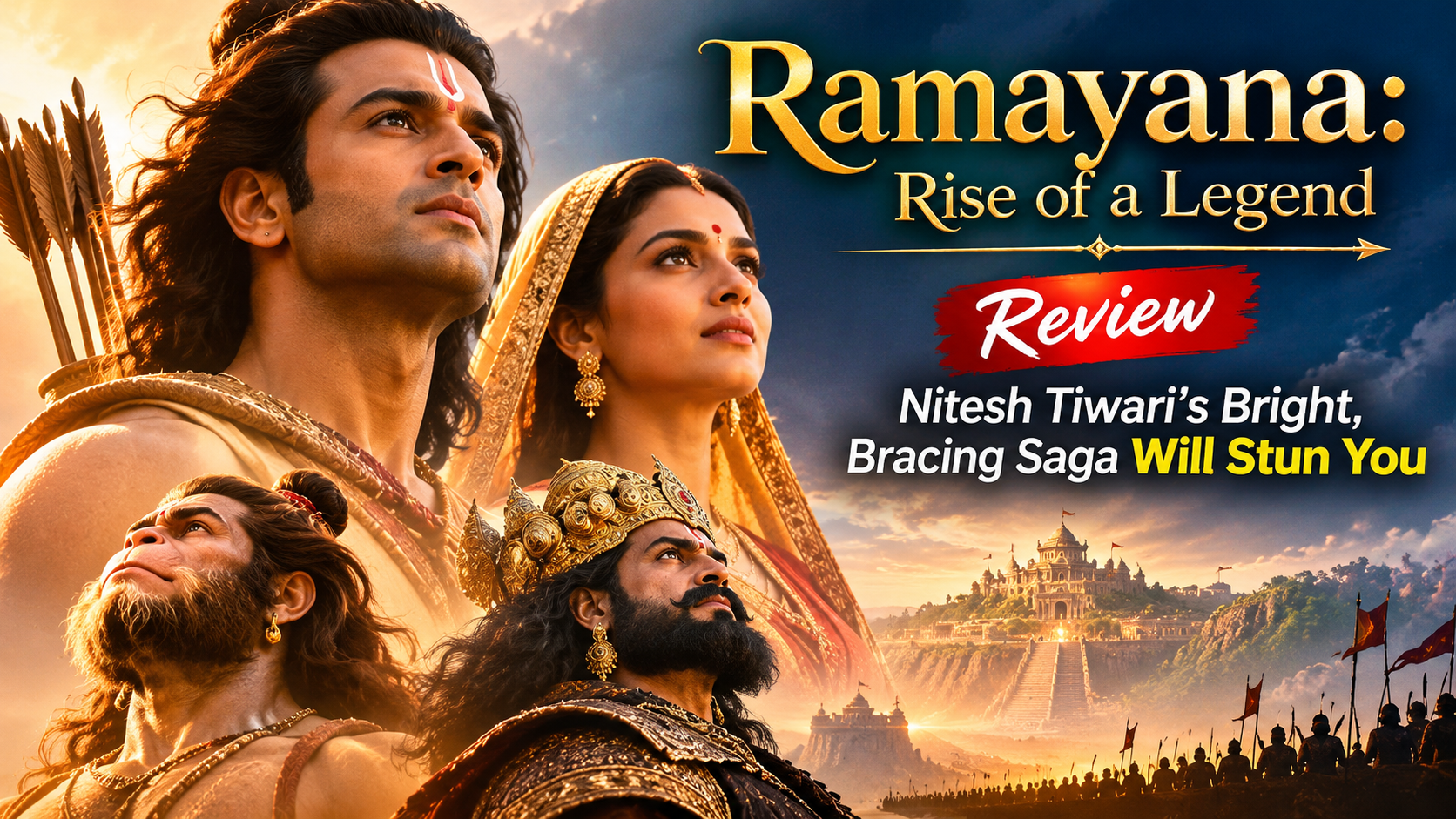
Ever since RRR released to cinemas in 2022, it seems as though Indian cinema has finally made a mainstream commercial impact in the US market. Now, every few months, a new Indian film with over-the-top CGI and an even more outrageous plot releases to cinemas. But to avoid imposter syndrome, I should make it clear that this is a review of ‘Ramayana’ the movie, and I am not going to point fingers if any detail hasn’t been interpreted as its shown in our fables.
Ramayana: Rise of a Legend tells the story of Ravana as he takes dominion of the three worlds after becoming nearly invincible. But he has one weakness: he can be killed by a human. So when Prince Ram starts making a stir after being exiled with his wife and brother, it’s clear that these two paths will cross in battle. It’s very traditional in its structure and very epic in its scale, which means it can be extremely predictable. Combined with the awkward pacing, which goes so fast at times and slams to a halt at others, I found myself just wanting it to get to the point. The entire film is leading to this big confrontation, and then it becomes clear that all the good stuff is being saved for the next entry.
Yash’s Ravana is built up to be the most overpowered villain that has ever existed. He manages to take on every single obstacle and does so with ease. The opening sees him take out an entire army by himself and makes it hard to see anyone else being able to topple him. His power is only cemented as the story goes on, and Yash has such an intensity and presence that the story suffers when not focusing on him. On the other side of the coin, Ranbir Kapoor’s Ram is essentially just the good version of Ravana in terms of his power level. He’s able to take on any challenge with such ease that it makes his journey quite predictable. It doesn’t help that Kapoor is rather bland in the role, and doesn’t have the same spark that Yash does as his adversary.
As the most expensive Bollywood film ever made (both parts cost nearly half a billion dollars), I expected a little more consistency with the special effects. Sometimes, it looks photorealistic, and other times it’s very awkward green screen. Very rarely are we treated to a shot that doesn’t have some kind of visual FX element, so it’s not shocking that the price tag was so steep. Just seems like they bit off a bit more than they could chew, and it results in some awkward visuals and plenty of physics-defying moments that aren’t magic related.
The score features hints of The Mandalorian, Lord of the Rings, and even Superman at various times. Which I suppose makes sense since we’ve got composers James Newton Howard, Hans Zimmer, A.R. Rahman, and Rishab Rikhiram Sharma all contributing. Though it should be said that the score can be a bit melodramatic with how much emphasis they try to put on the climax of every scene or character introduction. It reaches unintentional hilarity as the music swells to the point of shaking the seat, even in mundane moments or in quick succession with other similar musical cues.
I saw this in a fully packed theatre, and nearly everything that Ravi Dubey’s Lakshman said got a massive reaction. Most of the time, it was just a simple line read, and the crowd would go absolutely nuts. It was at the point where I was just fascinated because I didn’t find anything he was saying to be particularly funny or charming, yet it was like the Beatles were coming on screen when he would appear. This kind of disconnect really summed up my entire experience watching the film. It was very unique, and I’m sure if you’re a fan of Bollywood, you’ll be more forgiving of what I found to be issues in the film.
I saw the Tamil version of Ramayana: Rise of a Legend in 3D, and that’s probably the way to go as it gives you the most bang for your buck. Not only does this version have 30 minutes of additional footage, but the dubbed version also has AI lip-syncing, which can cause a strange uncanny valley effect. Though, I should point out that the 3D dims the image so much that I could hardly make out details during many of the night scenes. Since the 3D is mostly just done to add depth, I would have preferred to actually see the full image.
In many ways, Ramayana: Part 1 is too anxious to be a story alone. It’s often weighed down by the pressure to represent the cinema of faith rather than the cinema of fantasy. Its identity as a cultural touchstone defeats its ambition as an artistic benchmark. It is so eager to be retold that, at some level, it forgets to be told. Ironically, the mythology has come full circle: there have been so many indirect renditions of the good-versus-evil template over the decades that a literal translation in 2026 feels like an interpretation of all those indirect ones. It’s been subtext for so long that the text looks like a derived consequence instead of an original epic.
The scale of the film is impressive, but the real ‘set-pieces’ in the Ramayana were always the characters, their choices and their conversations. The sensory overload of the visual grammar — green-screen backgrounds, vivid colours, skies, cosmic glows, monsters and mayhem — is designed to offset the risk-averse dialogue and flat interactions. They do and say things because it’s written; any deviations might be blasphemous. For instance, the pre-interval scene of King Rama being asked to give up the throne and go on exile by his heartbroken father is supposed to reach an emotional crescendo. It is technically an action sequence where every word is an arrow and every command, a puncture wound. But the score of Hans Zimmer (in the rousing scenes) and A.R. Rahman (in the edgier ones) works overtime to do what the staging and actors cannot: provide a psyche beyond the spectacle.
You want to feel the son’s righteousness guilt-tripping the elders. A similar moment in S.S. Rajamouli’s Baahubali 2: The Conclusion earns the despair of the man obeying his mother, but Tiwari’s license to evoke is suspended by the fear to create. It’s media-trained mythology: there is no losing in this case, but there is no winning either.
Which brings us to the film’s Padmaavat-sized problem. When the valour is so calibrated, the antagonist is bound to steal the show. The best stretches of Ramayana revolve around Yash’s Ravana, because it’s the one time the makers aren’t shackled by the rules of engagement and devotion. The warrant to experiment liberates the film in these portions. It opens with his backstory, and it’s a backstory so compelling that it almost undoes the DNA of the epic. It pays so much attention to Ravana as a wronged Asura and a king blessed with immortality that it’s difficult to fault him; he protects his subjects in Lanka, fights for his family, respects women, brings prosperity, and is driven by principle.
Yash as Ravana in the film
The screenplay humanises him to an extent where the impending rivalry and war become a footnote; the most striking set-piece, too, features him abducting Sita (Sai Pallavi) on the Pushpak Vimana. The film operates in a separate tenor when he’s on screen, raising its game in honour of the elasticity it is afforded. It’s easier to play to the gallery as a villain, but the construction of Part 1 — where both rulers occupy journeys that are yet to intersect — lends Ravana a sense of individualism. It’s not entirely intended, but the film is better for it.
Our perspective is also derived from the fact that Yash plays him not too differently from the hyper-masculine beards we’ve seen across Indian cinema in the last decade. We are so wired to perceive them as tortured tragic figures for whom rage and revenge are expressions of love and morality that the ‘heroism’ of Ravana is hard to escape.
It’s tempting to believe that he’s the first ancestor of the greyness we see in new-age movies, but it’s the other way around. He’s the descendant of this trend, which makes Yash’s presence so strange: like a future hero from the real world disguised as a mega-villain of mythology. In other words, yesterday’s Ravana is today’s Kabir and Ranvijay and Pushpa.
It’s no surprise, then, that the revelation of his ten heads drew the loudest cheers of the screening; it’s the one intro sequence that rewards the anticipation. After all, who doesn’t want multiple personalities — and genres — for the price of one? Who doesn’t want more voices in a film that chants its way to history?
 chaiaursamachaar.com