

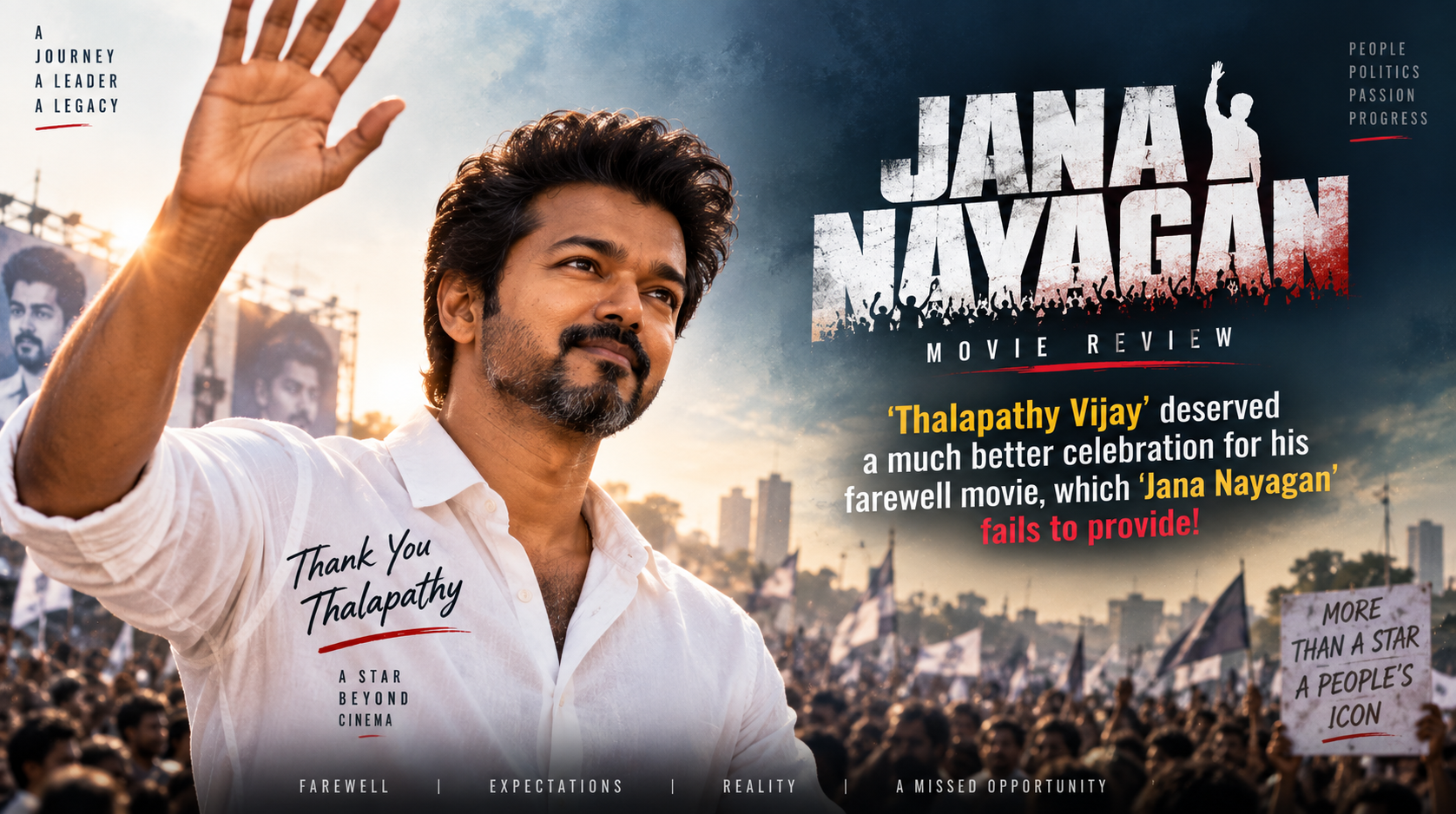
There is a very specific kind of nervousness that builds up before watching a film that is
someone’s farewell, and that is exactly what I carried into the theatre for Jana Nayagan. I
walked out with mixed feelings, and by the time I sat down to put my thoughts into
words, I realised this wasn’t going to be a simple one to write about.
I had no idea going in that H Vinoth’s latest, and Thalapathy Vijay’s last film, is a remake
of a Telugu film called Bhagavanth Kesari, written by Anil Ravipudi. I haven’t watched
the original, but that fact alone told me what kind of film Jana Nayagan was likely to be,
and sadly, that instinct wasn’t wrong. Jana Nayagan is yet another template mass
commercial entertainer, dressed up to look bigger than it actually is.
The film opens in 2026, where we see a group of poor villagers being denied their right to
vote, with the politicians in power directly responsible for this injustice. A cop then
begins narrating a story to a little girl, and that is how the main plot unfolds. This framing
device mildly lost me right at the start, and it is a choice I never quite warmed up to
through the rest of Jana Nayagan.
As expected of a film like this, we first meet our hero, Thalapathy Vijay, in an elaborately
choreographed fight sequence set in a prison. Some details about his character are
revealed, while others are held back for later, and those reveals are meant to surprise us,
but they sadly don’t land the way they should. What did surprise me, pleasantly this time,
was the absence of the usual celebratory entry song for the hero, a staple of this genre
that Jana Nayagan chooses to skip, and I found that quite welcome.
Then comes the villain of Jana Nayagan, played by Bobby Deol, and much like the hero,
his character too is built with some things revealed upfront and some kept for later. His
backstory is genuinely interesting even if it isn’t the most original idea on paper: an ex-
cop who turns to the dark side and joins forces with the real threat of the story, a corrupt
politician played by Prakash Raj, together plotting to bring the country down.
Our heroine, Pooja Hegde, is introduced with a subtlety I didn’t see coming, and I mean
that as a genuine compliment. The romance angle between her character and Vijay’s is
kept so minimal that Jana Nayagan doesn’t even bother with a conventional love song in
a picturesque foreign location, and this turned out to be one of the smarter calls the film
makes, a restraint I wasn’t expecting from a film of this scale and one I walked away
admiring.
The real purpose behind toning down the romance seemed to be making room for the
hero’s relationship with his daughter, played by Mamitha Baiju, an equation that
unfortunately never quite comes alive on screen the way it was probably intended to,
though I will give the film credit for at least attempting to prioritise that bond over a
routine love track
Where Jana Nayagan genuinely impressed me, and this is easily the strongest part of the
whole film, is its political commentary, which goes well beyond bold for a film of this
scale. There is a moment where a politician says that only two parties have been looting
the nation’s wealth for years and refuse to let any third party get a share of that privilege,
and hearing a line like that in a mainstream 2026 hero film caught me completely off
guard, in the best possible way.
The film also delivers a genuinely powerful statement on communal harmony, and it
does this by showing exactly how political parties and leaders divide people along the
lines of religion and caste, deliberately spreading hatred to serve their own interests, a
portrayal that feels uncannily relevant to the political climate we are living in right now.
This is easily one of the most striking things I have seen a mainstream hero film say out
loud in a long time, and Jana Nayagan deserves real credit for having the nerve to say it.
I know some people will dismiss this entire angle as the lead actor using his own film as a
platform, especially given his transition into public life, and I won’t fully argue against
that reading. But even accounting for that, I would count this political thread among the
genuinely strongest things I have seen in a mainstream entertainer in a while, and it is
the one part of Jana Nayagan I walked out wanting to talk about, even with a fair amount
elsewhere in the film that deserves honest criticism.
For most of its runtime, Jana Nayagan feels like it is caught in a tug-of-war between
wanting to be a breezy, harmless mass entertainer and wanting to be a film that says
something urgent about the times we live in, and by the end, it becomes clear the film
manages neither convincingly. There’s a stretch where our attention, so carefully earned
through a tidy introduction of all the central characters, simply stops translating into any
real investment in where the story is headed.
The final half hour of Jana Nayagan, the portion that should have delivered the biggest
punch, is genuinely exhausting to sit through, because the predictability of it all is hard to
shake off, and it stretches an already long 183-minute film into something that feels like it
will never end.
By the last hour, I could see people around me yawning and stretching in their seats, a
fairly telling sign of how badly the film loses its grip by that point. When Jana Nayagan
cuts back to that opening frame of the cop narrating the story to the little girl, I genuinely
felt like my patience was being tested. I knew the moment was coming; I even knew
roughly what it would lead to, and by then I was tired enough to have preferred a sudden,
unceremonious ending. And yet, there was a lovely surprise waiting right at the end
credits, one that softened the blow a little.
I did quite like the film’s approach to its music, composed by Anirudh Ravichander. The
number of songs is fairly standard for a commercial entertainer of this scale, and what
stood out to me is how most of them barely interrupt the flow of the story, playing gently
in the background instead of demanding a pause. Only two tracks really step forward and
ask for your attention, carrying the grandeur you would expect from a big song sequence,
while the rest stay wisely tucked away.
Visually, Jana Nayagan is only ever functional, never more. Sathyan Sooryan’s
cinematography leans heavily on the same urban backdrop lit up with flashy lighting that
this genre has used a hundred times before, and after a point, watching yet another
messiah-like hero save the nation against that same visual language starts to feel
tiresome.
The special effects and VFX are hard to sit through right from the very first instance they
show up, and I wouldn’t even call the production values impressive, because the film ends
up looking like practically every other entry in this space. Pradeep E Ragav’s editing does
little to lift this feeling either, given how stretched the pacing gets in the back half.
The performances follow a similar pattern. This isn’t a film where anyone is doing career-
best work, and sincerity from every familiar face is really the most one can expect walking
in. Bobby Deol, Pooja Hegde, Mamitha Baiju, Prakash Raj, Priyamani, Revathy, Nassar,
Sunil and Gautham Menon all deliver exactly what’s asked of them, nothing less, nothing
more, and none of them leaves you with a moment you will carry out of the theatre.
And then there is the man everyone showed up for, Thalapathy Vijay. I will admit I
missed the swagger and screen presence that define him, the very things we all wanted
from his final outing on the big screen. Perhaps H Vinoth had a different vision for this
role, one that asked Vijay to hold back rather than perform to the gallery one last time,
and there’s something almost touching about an actor choosing restraint over spectacle in
his farewell film, even if I will be honest that this particular choice doesn’t work in the
film’s favour. There isn’t a single scene in Jana Nayagan built around his presence in the
way his career has always allowed for, and that is the one thing about this send-off I
found genuinely hard to make peace with.
As disheartening as watching Vijay in this diminished form feels, especially knowing it is
his last film, the end credits genuinely turn magical, and if you have ever liked this man
as a performer, even a little, it is hard to keep your eyes dry as the end credits roll. It goes
some way in making up for the send-off a star of his stature truly deserved.
I wouldn’t call myself his biggest devotee, but I can’t pretend I didn’t enjoy watching him
on the big screen. I always walked into his films with genuine excitement, fully prepared
to walk out disappointed, and that particular excitement of watching this superstar with
his effortless charm in a dark theatre is something I already know I will sorely miss. The
goodbye Jana Nayagan gives him isn’t quite the one he deserved, much like the film itself
falls short of being the send-off it could have been, but between that political courage I
didn’t see coming and those last few minutes of end credits, there was enough here to
make me glad I showed up. All I can really say at the end of it is thank you, Vijay, for the
movies, and for turning every release into a festival of its own.
Courtesy: Written by Raghav Ravichandran