

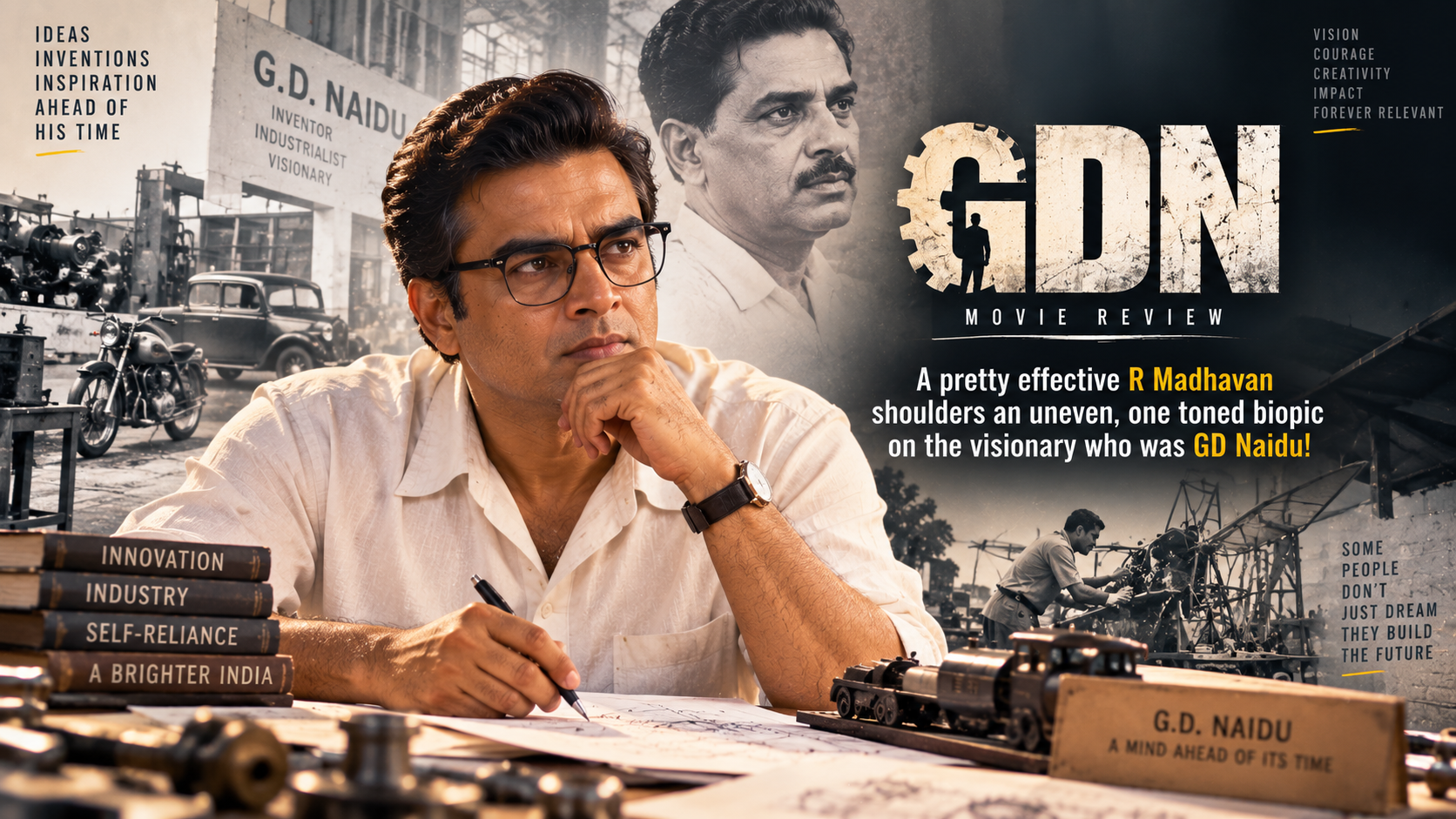
There are films you carry home with you, replaying scenes on your
way back, and then there are films like GDN, where you have already
moved on to planning dinner before the end credits have finished
rolling.
I walked into GDN with a fair bit of anticipation, mostly because R.
Madhavan hasn’t really put a foot wrong when it comes to picking
real-life stories to bring to screen, ’Rocketry’ being proof enough of
that. So when GDN was announced as his next, a biopic on
Gopalswamy Doraiswamy Naidu, the legendary inventor and
entrepreneur fondly remembered as the Edison of India, I was fairly
certain I was in for a solid watch. GDN, unfortunately, left me largely
dissapointed.
A biopic is a tricky genre to get right in today’s cinema, and not just
because of what parts of a person’s life you choose to put on screen. It
is just as much about how you choose to tell it, and this is exactly
where GDN stumbles badly. The film is narrated in flashback, framed
around a school curriculum committee debating who deserves a place
in history textbooks, which (as an idea) is fair enough on paper. It
does make you pause and think about who really earns that spot. But
as a device to carry an entire feature film, it just doesn’t work. It
comes across as too subdued, almost lifeless, right from the setup.
Now, it is entirely the director’s call on what to show and what to
leave out about the man the film is built around, but stretching that
story into a template mass-commercial potboiler doesn’t make GDN
any more gripping.
We watch events from GD Naidu’s life pass by one after another in
strict chronological order, and no matter how fascinating these
individual moments might be on their own, painting the hero as
endlessly, one-note righteous sucks every ounce of thrill out of what
should have been an inspiring watch.
I have no quarrel with the facts GDN presents; they may well be
gospel truth, but framing the protagonist like a hero straight out of a
two- or three-decade-old potboiler, someone who is worshipped and
celebrated at every turn, leaves the film feeling stagnant.
Then there is the antagonist, a character who is outright,
unmistakably negative, and it is honestly hard to buy into him
because he feels too textbook, too filmy, and it ends up making the
whole biopic look staged rather than authentic. This template
approach, borrowed straight from a mass commercial potboiler,
simply doesn’t suit a film meant to honour a real person’s legacy. The
treatment is so flat throughout that GDN never manages to feel
aspirational, which is ironic given who it’s about. And the underlying
message it’s trying to send, about the perils of putting film artists on a
pedestal, ends up landing as painfully preachy rather than thought-
provoking.
GDN often plays out like an actual television serial, complete with
scenes where crowds of people rally behind the protagonist as though
he were some kind of messiah. There is an auction sequence in
particular that felt so implausible I found myself thinking: this is
straight out of a daily soap.
The film doesn’t shy away from throwing twists and high points into
its narrative, but each one lands as tedious rather than thrilling, so
much so that even predictability starts to feel like the least of GDN’s
problems. That is genuinely how underwhelming things get. At one
point, a character says something crucial, and all you hear is the
background score blaring over it, leaving you to guess at the dialogue
entirely. It is tough to take a film seriously when it treats something
like that so casually.
Speaking of the score, it isn’t just loud; it feels almost entirely
redundant through most of GDN’s runtime, constantly nudging you
on what to feel at every single beat instead of letting the scene do that
work. And I am still struggling to process that the songs, which
honestly are quite forgettable, were composed by the immensely
talented Govind Vasantha. It is genuinely hard to reconcile, because a
composer of his calibre rarely misses this badly.
Visually too, GDN doesn’t offer much to hold onto, so hoping for any
sort of aesthetic richness might be asking for too much here. Like
most period dramas, this one had every opportunity to experiment
across set design, costumes, lighting, special effects, essentially
everything that shapes the look of a frame, but it falls short at nearly
every turn.
Large portions are shot against green screen, and it shows, leaving
the film looking noticeably weak on the visual front. Nothing about
the production design, the effects, the costuming, or the lighting
manages to hold your attention even briefly. It plays out less like a
regular period piece and more like a wasted opportunity.
If there is one thing working in the film’s favour, it is the cast, packed
entirely with familiar faces, and that ends up being something of a
blessing in disguise. You will barely spot anyone you don’t recognise,
which at least sets clear expectations for what you are getting
performance-wise.
Everyone on screen is sincere in their effort, but also far too
predictable and excessively theatrical, which makes it impossible to
form any real connection with them. At best, they are inoffensive,
mostly because actors with this much experience would genuinely
struggle to give us a bad performance even if they tried.
R. Madhavan, playing GD Naidu, essentially comes across as R.
Madhavan and nothing more. There is barely any visible effort to
shift even slightly into the skin of a man who actually lived and
breathed, someone the audience deserved to see rather than the actor
playing him. It feels like he approached GDN the same way he would
any regular commercial entertainer, banking on his usual sincerity to
carry things through, except here, that same sincerity works against
him.
Despite everything I have laid out, the performances remained the
one faint bright spot through GDN’s runtime, because somewhere
past the midpoint, the film stopped feeling actively bad. It never quite
manages to pull you in, not once, but it also stops registering as an
unworthy watch.
Maybe it’s the mild curiosity around GD Naidu’s own story doing the
heavy lifting, or maybe an hour or two in, you simply go numb to the
letdown and stop expecting more from GDN. At its absolute best, it
becomes tolerable, but never once does it turn thrilling, absorbing, or
even mildly enjoyable.
Did GD Naidu’s story deserve a cinematic adaptation? Perhaps, yes.
Did it deserve a far better execution and a storytelling approach
worthy of his legacy? Absolutely, without question, because the big
screen certainly deserved better than what GDN ends up delivering, a
film that feels far closer to a television serial than the cinematic
tribute its subject was owed.
Courtesy: Written by Raghav Ravichandran