

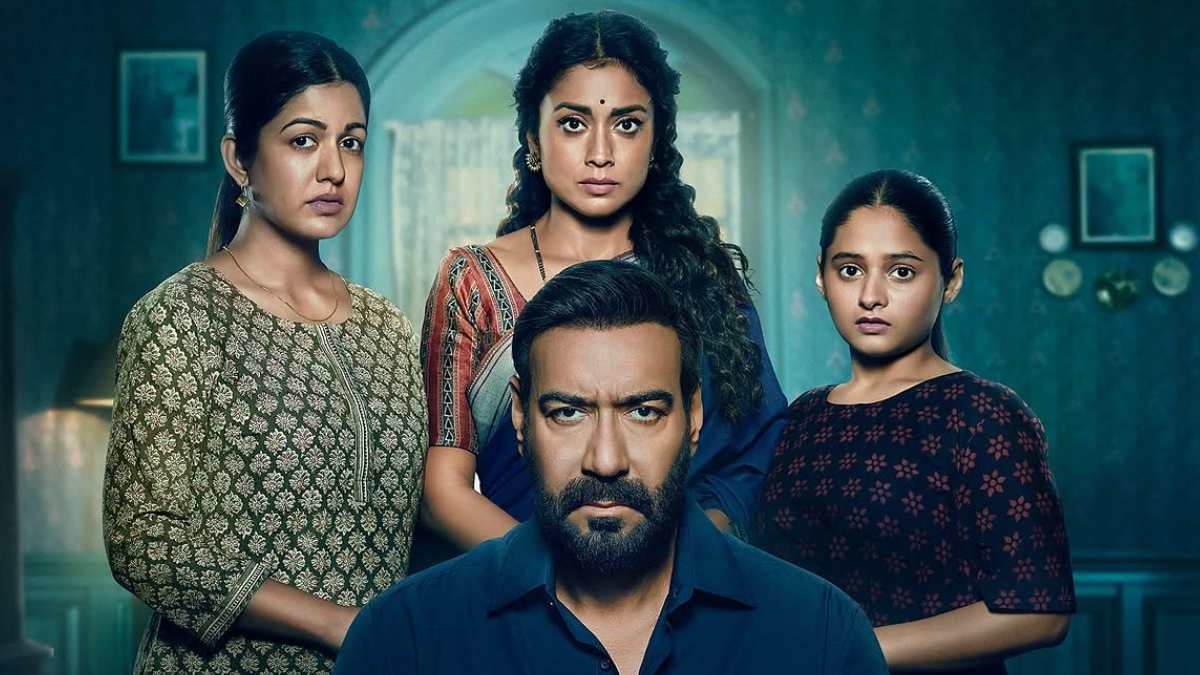
Ajay Devgn is back as one of his most loved characters, Vijay Salgaonkar, and most probably for one last time in Drishyam: The Conclusion. The Drishyam franchise has rightfully earned its place in pop culture as well as among the audiences.
It is solid material to enjoy as a viewer and celebrate wholeheartedly, and one of the rare offerings from Indian cinema that the audience genuinely won’t get tired of. When Nishikant Kamat helmed the Hindi remake of this Malayalam marvel in 2015, it got all the love and appreciation it deserved because the film was fascinating on a whole
new level.
As someone who loved the original, I happily appreciated the filmmaker’s work there. When Abhishek Pathak took charge of Drishyam 2 in 2022, the audience showered it with as much love as its prequel, but I wasn’t very impressed because I felt the essence of the core material didn’t come through in the execution of the Hindi remake.
With Drishyam: The Conclusion, the film barely follows anything the original Drishyam 3 offered in its story, and as much as that should be reason enough to celebrate, it became the biggest reason for my unexpected and shocking letdown. I wasn’t prepared in any capacity for this lacklustre offering of something I admire and enjoy. These thoughts on Drishyam: The Conclusion come from someone who genuinely loves this series.
Drishyam: The Conclusion, as expected, starts where Drishyam 2concluded. Vijay Salgaonkar’s family is relieved that the case that made life hell for them isn’t coming back to bite them. Meera (Tabu) and Mahesh (Rajat Kapoor) Deshmukh have other plans. They reach out to SP, IPS Crime Branch Rajveer Tomar (Jaideep Ahlawat) with a request to reopen the case of their missing son.
The drama/game between Vijay and the cops resumes here, and we pretty much know the drill. Instead of fearing predictability and familiarity, we happily place our faith in the Drishyam series, and nothing is much different while watching this film. I felt this faith of mine was taken for granted by Abhishek Pathak. I was okay with him not religiously following the narrative of the original for this third instalment, but offering something so uninteresting is something I can’t come to terms with. I am also okay with the narrative taking half the film to set up the finale, but failing to deliver the chills and thrills we expected, and failing to keep us on the edge of our seats at any point, is disappointing. The execution constantly misses the mark and struggles to earn our interest and investment the way it did in theearlier two films.
The writing of Drishyam: The Conclusion doesn’t really falter, andthat is evident almost throughout. Take, for instance, the scene
between Rajveer and Savio, where the former questions the latter.
The drama, the dialogue, the reactions, everything in this scene feels potent, but it doesn’t come across as even mildly impactful. Even when Rajveer meets Vijay for the first time at the latter’s house, we can sense the potential intensity of that moment, but the scene barely makes a mark.
The drama and slow motion around Rajveer’s entry and the humour that comes with Gaitonde’s character feel out of place because they drain the seriousness and suspense this film needs instead of adding to it. Vijay’s lawyer enters the narrative in the second half, making everything before it look like nothing but faff, and I say so because the narrative invests a substantial amount of time in the courtroom, where the drama is over the top to the point of coming across as pretentious. This half-hearted execution fails to make us feel the thrill and suspense of the film. No matter how badly a filmmaker makes or remakes Drishyam, it can’t be without thrills and suspense, and not sensing them at all in Drishyam: The Conclusion is its biggest drawback.
The drawbacks don’t end here. Despite falling in the suspense thriller genre, the film’s pace is its biggest problem, and it is a bigger one than we can even imagine. I saw the film in an almost packed theatre and sat in the top row, and I can’t believe the number of phones that kept lighting up (almost) throughout.
This showed me I wasn’t the only one finding the film uninteresting and below expectations. To be precise, the pace is borderline sluggish, and that costs the film a lot. The appropriately intense but inappropriately loud background score adds to this problem. There were so many scenes where it was strongly evident how the score was affecting the moment, and how the moment was relying on that loud score when it didn’t need to. I can’t explain what a major letdown this blaring sound was for me. Visually, the film isn’t bad as such and doesn’t draw criticism instantly, but the world and the people in it look a bit too polished for us to take them seriously. That rawness and emotional rootedness were completely missing from the visuals. I was admiring Tabu’s costumes and Shriya Saran’s hairstyle more than anything else, and while that shouldn’t really be a bad thing, it is
in this film.
I found Drishyam: The Conclusion emotionally aloof beyond what we can imagine and even accept. Instead of admiring what Tabu wore in a scene, I struggled to feel the pain of a mother who still doesn’t know about her son, missing for over a decade now. Instead of Shriya Saran’s hairstyle catching my attention in an important courtroom scene, I wanted to feel the fear under which she has been living all these years, more so because, in the witness box, she is questioned about unintentionally spilling the details of the family’s actions in Drishyam 2, which could still land them in more trouble.
At no point did I feel Vijay Salgaonkar’s inevitable frustration and exhaustion from skilfully saving his family for so long. As a human, in such a situation, anyone would want to surrender, give up or accept defeat at some point. Even if we want to give the advantage to Vijay Salgaonkar out of love after witnessing his brilliant mind for years, seeing him reach a breaking point would make him look more human and help us connect with him emotionally. It is not much of an ask from us, but more of a craving for humanness and rationality from someone we are fond of.
Ajay Devgn as Vijay Salgaonkar is in his finest form, as expected. We will never get tired of seeing him in this character, and this time is no different. His intense eyes continue to be a sight to watch out for. Seeing him do most of the job with the least talking continues to be admirable and enjoyable. Shriya Saran as his wife and Ishita Dutta and Mrunal Jadhav as the daughters have little to do in the narrative this time, so their presence doesn’t really register. They are sincere and nice, just not impactful enough. Rajat Kapoor and Tabu, on the other hand, are impressive and solid despite the limited screen time. Both were an absolute joy to watch, reprising their roles with the requisite sincerity and seriousness and maintaining that essence. Even though Gaitonde’s humour didn’t work for me, I liked watching Kamlesh Jadhav in the role. He gives us a sense of familiarity with the world of Drishyam and makes us nostalgic too. New entrant Prakash Raj gets the most unchallenging part, and he plays it with so
much drama that I wanted to question the brief he received to deliver such an unreal and unnatural performance. The other new entrant, Jaideep Ahlawat, aces his act, almost overpowering everyone in this ensemble, including Ajay Devgn and Tabu. Even when a moment isn’t satisfying enough for whatever reason, his presence instantly makes
it better. He is outstanding beyond words and, most importantly, he doesn’t remind us of the fantastic Akshaye Khanna even for a second.
Jaideep Ahlawat was the silent star of this film. If there was something genuinely worth admiring wholeheartedly, it has to be
him.
Drishyam: The Conclusion isn’t traditionally or typically bad or unwatchable as such. Its core material, and the world it has built over a decade with such sincerity, is good, rather great enough to get us instantly invested, and with that same excitement I went in for the movie in a packed theatre.
My excitement played a bigger role in leaving me disappointed than the filmmaker’s craft and skill. Even in the final stretch, when the film is at its peak of offering thrills, twists and suspense, I found it more familiar than fun. Thrill, suspense, twists, intensity, seriousness and everything else I was looking for were clearly seen but nowhere to be felt throughout the film.
Even when I found the Hindi remake of Drishyam 2 underwhelming, I witnessed moments where my faith in the franchise and fondness felt respected, but this time the film completely missed the mark for me. Being lenient for the sake of my love for it was out of the question, and my heart breaks to say this simply because of the excitement with which I signed up for it.
Raghav’s Final Verdict: Drishyam 3 has its moments of brilliance despite its many pitfalls. Personally, I found it more interesting to sit through compared to the original Malayalam version.
Raghav’s Rating: 2.75/5
Courtesy: Written by Raghav Ravichandran