

What do you expect from a romantic drama? A boy and a girl meet. They can’t stand
each other. Circumstances, usually an accidental trip together, force them into proximity.
Reluctant conversations turn into stolen glances, shared silences turn into love.
Then comes the conflict: parents, family, society, and unresolved baggage. After much
emotional turbulence, love wins. Permission is granted. Wedding bells follow. Roll credits.
Formulaic? Absolutely. But when done right, it works. When conflict meets conviction and
resolution earns its place, even the most predictable love story can feel warm, lived-in,
and affecting.
Tu Meri Main Tera Main Tera Tu Meri(TMMT for convenience) knows this formula all too
well. In fact, director Sameer Vidwans proudly spells it out by listing the “seven stages of
love” that supposedly shape every love story, and the film.
He, or rather Ananya Panday’s character Rumi, calls it “Hookup me 90s wala pyaar.” The
irony is hard to miss. Despite ticking every romantic checkbox, TMMT remains a
strangely tedious watch, largely because its choppy, unfocused narrative never allows
you to truly sink into its world.
What you see on screen are two undeniably good-looking people falling in love. What
you don’t feel is anything beyond polite detachment. You remain aloof, unconcerned
about why things are happening the way they are, or whether they even need to happen
at all.
The one-liners and dialogues often make you cringe, and until the interval, the film plays
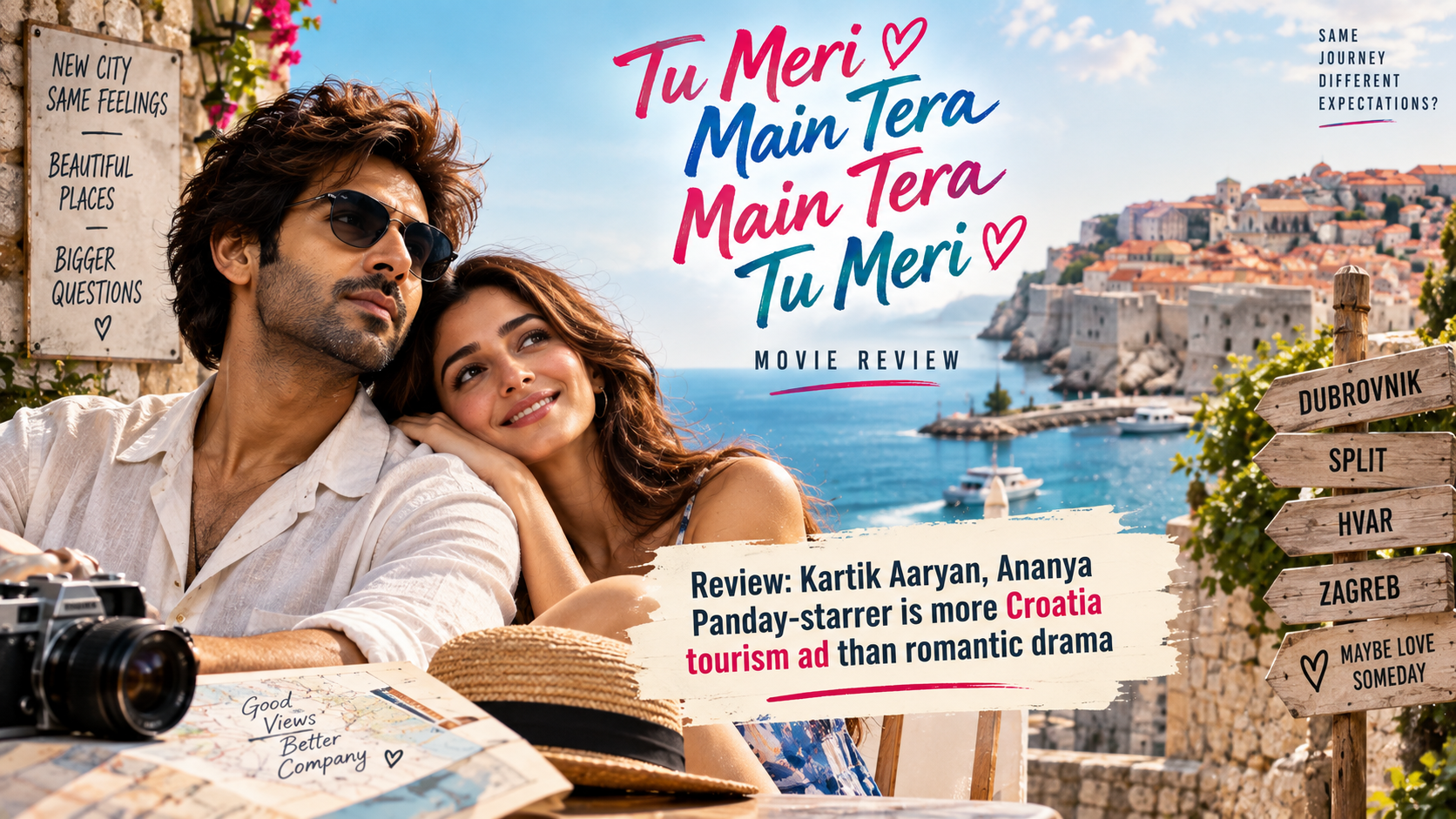
out like an extended Croatia tourism brochure with sunsets, cobblestone streets,
and aesthetic longing. Post-interval, it abruptly pivots into “Yeh mera India, I love my
India” mode, as if switching emotional gears mid-journey will automatically add depth.
Half the dialogues feel pointless. Case in point, when Neena Gupta’s character, Pinky
Mehra, says, “Mujhe Indian bahu nahi chahiye.” At the risk of minor spoilers, what initially
seems like a potentially significant obstacle in the protagonists’ journey ends up being a
head-scratcher. You’re left wondering not just about the relevance of that line, but about
the necessity of many scenes and conversations in the film. Did they add conflict? Did
they deepen character? Did they move the story forward?
Most importantly, was there any real reason to stretch this film to nearly two and a half
hours? That question lingers long after the final frame fades.
The dialogue is a big hurdle- cringe-heavy, painfully self-aware, and often landing with
the thud of jokes that should’ve stayed in the writer’s room.
And then there’s the storytelling. Or the absence of it. The characters are written with so
little depth that you never really connect with them. You don’t dislike
them, you simply remain aloof, emotionally uninvolved, watching people exist on screen
without ever understanding who they truly are.
The direction swings wildly, unsure whether it wants to be a breezy rom-com, a travel
fantasy, a coming-of-age love story, or even a surface-level feminist tale, and ends up
being none of the above.
The film feels less like a film and more like a very expensive tourism brochure, one that
desperately wants you to book a ticket to Croatia while pretending to tell a love story.
Croatia looks stunning. Sun-drenched coastlines, postcard-perfect streets, lingering wide
shots that scream “This is your new paradise.” Even Agra, briefly featured, is captured
with a visual sensitivity that the rest of the film sorely lacks.
The background score earnestly tries to stitch together emotion, momentum, and mood.
Unfortunately, it’s trying to elevate a narrative so patchy that the effort feels Herculean.
Coming to the performances, Ananya Panday appears completely clueless, struggling to
bring conviction or nuance to a role that already gives her very little to work with. She did
show her spark in films like Kho Gaye Hum Kahan. However, here, it looks impossible for
her to outperform a role that, anyway, only requires her to look pretty.
Kartik Aaryan, meanwhile, is… Kartik Aaryan. Same energy, same rhythm, same PJs
and toothy smile. He proves that he can emote and act but even when he sheds tears, it
doesn’t move the audience or make us feel connected. This time, it’s his abs doing most
of the heavy lifting.
Neena Gupta and Jackie Shroff try their best to do justice to the character offered to
them. Chandni Bhabda makes her debut with the film, playing Ananya’s sister. She still
sounds like Alia Bhatt, but her performance was easy to the eyes.
STORY CONTINUES BELOW THIS AD
Raghavs Final Take:
Watch TMMT it if Croatia is on your bucket list and you need cinematic motivation to
finally plan that trip. Or if you’re a die-hard Kartik Aaryan fan who will laugh at any joke he
cracks, no matter how tired. For everyone else, this one’s best admired from a distance,
much like its characters.
Rating: 2 (out of 5 stars)
Courtesy: Written by Raghav Ravichandran