

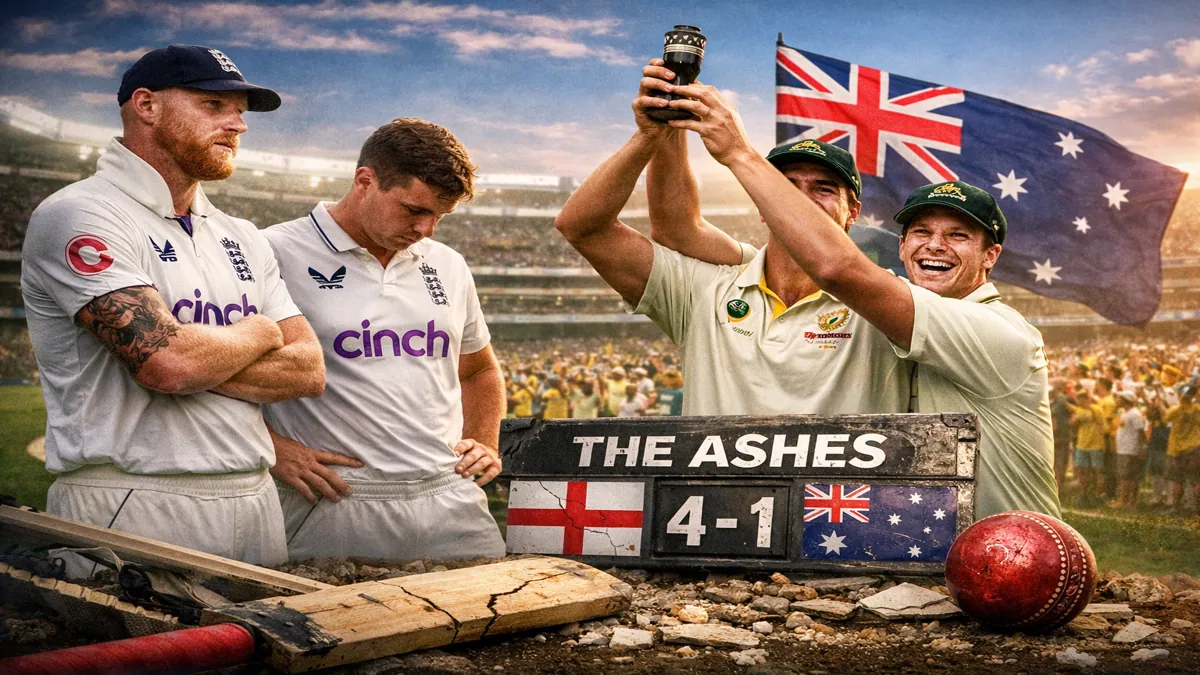
England’s Ashes humiliation was more a series of letdowns than ‘Bazball’, creating any impact on Australian shores
They landed in Perth expecting to challenge Australia, but after a 4-1 defeat and more off-field revelations, the laid-back approach of McCullum’s regime is in the ECB’s sights.
It was billed as “the series of our lives” by Brendon McCullum, but as he and Ben Stokes looked over towards the podium to watch Steve Smith and Pat Cummins lift the crystal Ashes trophy under an azure sky, the optimism that English fans had before this Ashes series felt like a lifetime ago.
They landed in Perth two months ago with what they and many thought was an aggressive, dynamic England side, finally ready to challenge Australia’s ageing champions after three miserable tours. Cue a 4-1 humbling, barring a surprise win at Melbourne, which really doesn’t count for much with the Ashes already lost in 11 days.
Ashes review launched by ECB as Stokes gives full backing to under-fire McCullum. England’s agony came to an end with the last rites only salt in wounds when at 2.30 pm, Alex Carey iced the target of 160 with a succulent cover drive, five wickets down. It was never truly in doubt, with Stokes standing there helpless at slip after another injury, forever wishing he had more runs to work with; that catches had stuck earlier in the match, or that his batters had made better use of a good pitch in their first innings.
There were positives in the match. Jacob Bethell stretched his maiden Test century to 154, which fulfilled the prophecies of Sir Garfield Sobers and Brian Lara growing up. Josh Tongue finished with 18 wickets at 20 runs a pop, Australia’s struggles with his angle and pace hopefully imbuing him with belief for future encounters.
But Tongue was parachuted in at 2-0 down, Bethell with the destination of the urn already decided. And over the course of seven weeks, ever since a bleak hour of batting was followed by the first of Travis Head’s three walloping centuries, it felt like England were always behind; ill-prepared and then confused as Stokes began preaching grit, McCullum still preached chill, and Mitchell Starc with 31 tickets in the series thereby getting a Man Of The Series award deservingly so!
As Australia basked in an all-too-familiar afterglow and said farewell to Usman Khawaja – his final act in Test cricket was a sajdah on the SCG outfield after walking out through a guard of honour – Richard Gould, chief executive of the ECB, announced an all-too-familiar review. Its remit? “Planning and preparation, individual performance and behaviours, and our ability to adapt and respond effectively as circumstances require.”
Planning and preparation – i.e., England rocking up half-ready – is something McCullum and Rob Key, the team director, have already held their hands up to. But “behaviours” is an interesting one, for a team that’s built its identity as a fungoing group who want to bring back ‘entertainment’ to Test Cricket, a tight-knit group that enjoys itself off the field.
As per Marcus Trescothick’s remark about the perils of driving on the up in Perth and Brisbane not being discussed with the players, it is also one that keeps the technical chat to a minimum.
Josh Tongue and Jacob Bethell (left) both enjoyed fine Tests at the SCG, and should probably have been in the team at the start of the series.
This laid-back approach did revive some of the older, pandemic-worn players during its early phase; players like Stokes himself, Jonny Bairstow, Jimmy Anderson and Stuart Broad. But, as products of the Andy Flower era, they already had the basics baked into them.
For the newer breed, this is pretty much all they have ever known. And having grassed circa 17 catches in Australia, blown good positions with the bat, and fed Head’s cut shot to point of it considering a January diet, the upshot is an opportunity missed.
Australian readers may bridle a touch here, their team having been second billing in their own country for much of a series they have dominated. They have delivered excellent, resourceful cricket, seizing the clutch moments and catches instinctively.
And they have also overcome high-profile absentees like Cummins for all but one Test (that Smith sat out), Josh Hazlewood for all five, and Nathan Lyon since his hamstring popped in Adelaide. The low key Scott Boland, 20 wickets, has delivered a clinic in thudding, metronomic discipline.
For England, Brydon Carse refused to give up and, while he leaked runs, he was a wicket-taker. Tongue and Bethell leave with reputations enhanced, while Joe Root ticked off the final gap in his CV (twice). But though Jofra Archer made his mark, he was still one of four quicks to break down. Matt Potts was ignored on the final day, as was Shoaib Bashir all tour. They opted for the buck-each-way Will Jacks, who had moments good and bad.
Others simply shrank, be it the once productive opening alliance of Ben Duckett and Zak Crawley or Ollie Pope’s slide out of the side. Jamie Smith was upstaged by Carey in both facets, while Harry Brook left folks in Australia perplexed, noting his hand-eye talent but also questioning his smarts at times. When news of a late-night altercation with a bouncer during the Ashes-preceding New Zealand tour emerged after Gould’s statement on the final day, everyone was questioning them.
One of the tenets of McCullum’s approach is that players should not be so consumed by cricket to the point of letting the best years of their life pass them by, blessed as they are to travel the world playing sport. On this tour, however, England have let the cricket pass them by in the process.
Courtesy: Written by Raghav Ravichandran