

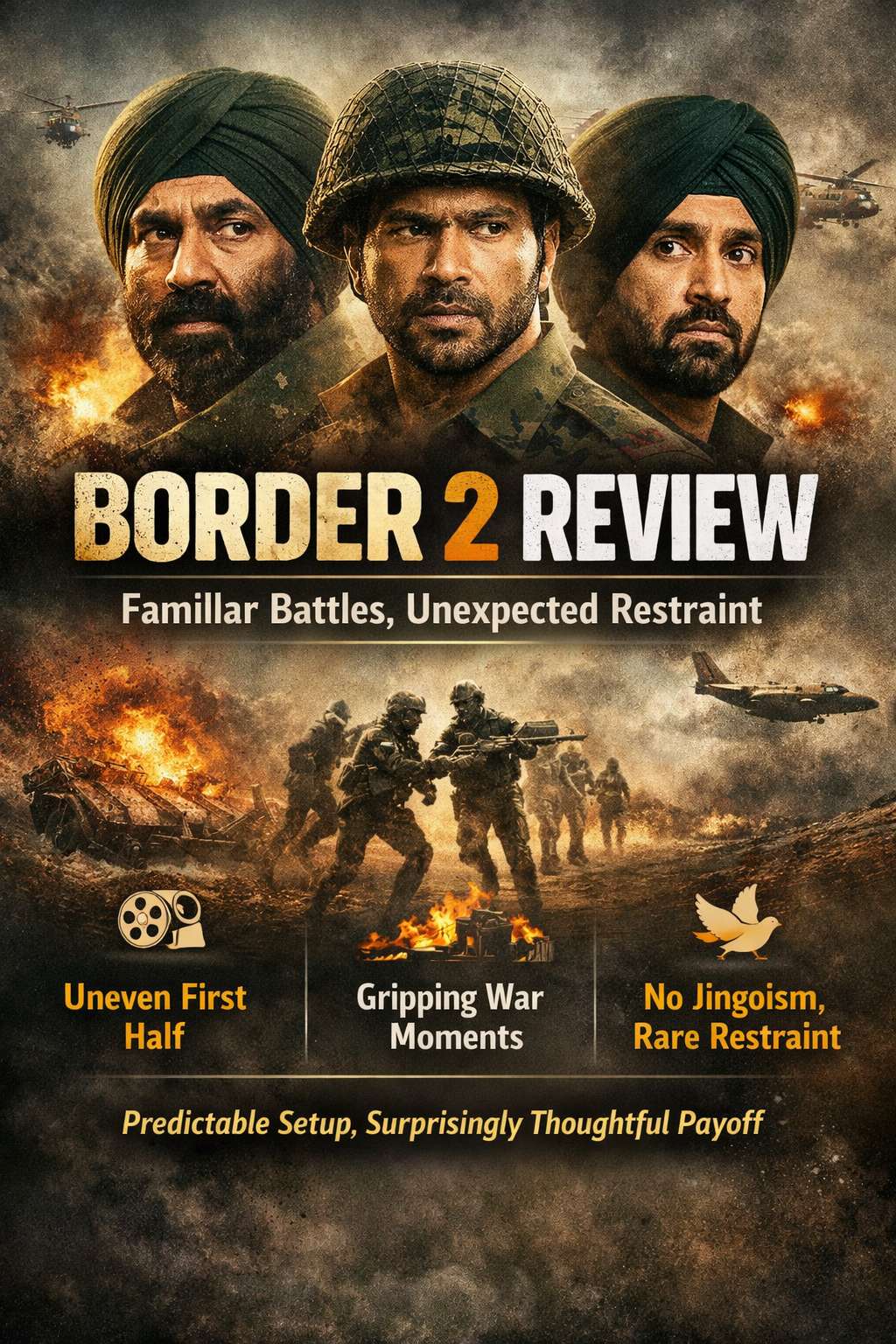
Border 2 isn’t really about what it offers; it is more about how it chooses to offer it. And that distinction matters, especially when the audience is already overfamiliar, almost fatigued, with the grammar of Hindi cinema war dramas.
We have seen these films repeatedly: brave soldiers, emotional families, swelling background scores, chest-thumping patriotism, and neatly drawn lines between heroism and villainy. Going in, I had fully prepared myself for another done-to-death war spectacle, and Border 2 does, to an extent, justify that apprehension. Yet, in a few crucial moments, it also pleasantly surprises.
Border 2 follows a rather predictable and uninspiring narrative pattern in its first half. We are introduced to the four protagonists one by one, and these entry sequences are wildly inconsistent in tone. Some made me genuinely question the creative choices, while others felt so overwrought that I found myself thinking, “This is just too much drama to process.” There is a visible effort to make each introduction impactful, but instead of building intrigue, they often feel forced and oddly staged.
Once the characters are assembled, the film shifts to extended banter during the training portions involving Varun Dhawan, Diljit Dosanjh, and Ahan Shetty. This stretch, unfortunately, is the most difficult to sit through. The exchanges resemble schoolyard squabbles rather than the camaraderie or tension one expects among soldiers preparing for war. The constant petty fights, bets, and exaggerated bravado dilute the seriousness of the setting and slow the film down considerably. At this point, Border 2 feels like a rough sail, struggling to find its emotional or narrative footing.
The film then pivots to introducing the families of these four central characters. None of these tracks truly shines, but some work better than others. Diljit Dosanjh’s love track stands out, not because it is particularly well-written, but because of his inherently warm and endearing presence.
Sunny Deol’s family angle, on the other hand, carries genuine emotional weight, largely due to Mona Singh’s performance and Sunny’s intense screen presence. Their interactions feel lived-in and sincere. In contrast, Varun Dhawan and Ahan Shetty’s backstories are disappointingly flat, adding little depth or emotional investment to their characters.
Up until this point, Border 2 remains underwhelming. But once the war portions begin, the viewing experience improves drastically, almost beyond expectation. The tonal shift is immediate and striking. The sequences involving Diljit Dosanjh and Ahan Shetty during the war are genuinely gripping. These moments are not just technically engaging but emotionally absorbing. I did not expect to be as engrossed as I was, and more importantly, these scenes earn admiration rather than demand it.
Interestingly, the war portions featuring Sunny Deol and Varun Dhawan feel comparatively dry. That said, this is less a flaw and more a limitation of how their characters are positioned within the narrative. There isn’t much scope to elevate these segments, so unnecessary criticism would feel unfair. They serve their purpose without leaving a lasting impact.
Visually, Border 2 is serviceable at best. The VFX, however, is a major letdown. It is poorly executed and often distracts rather than immerses. Despite being set in the 60s and 70s, the film shows little interest in experimenting with costumes, textures, or even colour grading. The era feels more like an afterthought than a lived-in world.
The music is a mixed bag. The newly composed songs struggle to coexist with Anu Malik’s original melodies, creating an uneven musical experience. As a result, the only tracks that truly work are the recreated versions of his classics. Ae Jaate Hue Lamhon still evokes that familiar ache of longing and separation, while Sandese Aate Hain, even in its new form, manages to give goosebumps. These songs remind us why the original Border left such a deep emotional imprint.
The background score, thankfully, avoids being unnecessarily loud or overbearing. It feels apt and, in fact, helps carry the film through its first, rather uninteresting hour. Later on, it settles comfortably into the narrative without drawing attention to itself, which is a relief in a genre often guilty of sonic excess.
Performance-wise, Border 2 largely opts for safety. It could have demanded more powerful, nuanced performances, but it chooses an easier route, and surprisingly, that choice doesn’t feel entirely wrong. Sunny Deol screams more often than necessary, but his rock-solid screen presence overshadows this minor inconvenience.
There is something reassuring about his old-school intensity that still works. Varun Dhawan, refreshingly, is not placed at the centre of attention and instead functions as a good supporting pillar. Within that limited space, he is effective. Ahan Shetty tries hard, but he has a long way to go before leaving a lasting impression. Diljit Dosanjh remains effortless, as always. He doesn’t steal the spotlight, but every time he appears on screen, the joy quotient automatically rises.
The women, unfortunately, have very little to do. Anya Singh appears in just two scenes, while Sonam Bajwa and Medha Rana are reduced to the most predictable female roles commonly seen in war films. Mona Singh stands out by bringing emotional gravitas to a familiar character. She portrays a woman weighed down by fear, strength, and unspoken resilience with quiet effectiveness.
What truly elevates Border 2 are three moments that genuinely surprised me. One is when Mona Singh tells Sunny Deol, as he leaves for war, to not only win the battle outside but also the one raging within him.
Another powerful moment occurs when Diljit Dosanjh asks his mother to bless him with courage, and she responds by saying that even the enemy’s mothers will be praying for their sons’ bravery. That line alone earned spontaneous applause. The third, and perhaps the most refreshing aspect, is how the film portrays the Pakistani Army, Navy, and Air Force; not as conveniently incompetent adversaries, but as equally strong forces. The scene where Sunny Deol lets a surrendering Pakistani soldier go beautifully avoids an unnecessary chest-thumping moment and stands out for its restraint.
Overall, Border 2 is inconsistently engaging. It stumbles as often as it surprises. While there are stretches that feel dull and underwhelming, there are others that feel twice as refreshing and thoughtful. In the end, it may still come across as another dry war film, but it deserves credit for consciously avoiding jingoism in a time when such restraint feels rare. That alone makes Border 2 worth acknowledging, if not wholeheartedly celebrating.
Courtesy: Written by Raghav Ravichandran